


Nowadays, the real need is to achieve maximum energy savings while still maintaining a high level of comfort.
This is an attempt to show how this can be achieved in hot water heating systems by installing an outdoor reset controller. The percentage of savings is the same whether in a commercial building or a single-family home. In this discussion we are assuming that exterior walls have decent insulation and the windows are good quality.
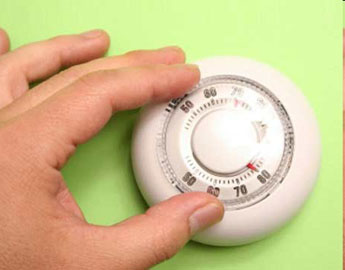
Most heating systems are controlled by on/off thermostats activating zone valves or pumps. These thermostats are not able to provide maximum energy savings because a) they are not accurate enough and; b) they are reactive. Even after they turn off, the thermal mass of the heating system will tend to overheat the space.
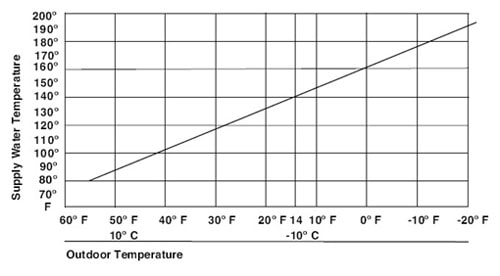
An outdoor reset controller, on the other hand, anticipates what is going to happen inside the building by constantly monitoring changes in the outdoor temperature. Based on this information, the controller adjusts the heating water temperature according to a reset curve as indicated by the figure below.
Colder outside – higher water temperature Milder outside – lower water temperature.
This results in a much more accurate indoor climate that does not overheat. By maintaining a more stable temperature the indoors can typically be kept a couple of degrees cooler without discomfort. For each degree reduction over a season, we get 2.5% energy savings. But that is only the beginning.
Existing zone thermostats remain in place but now act primarily as high limits in case there are heat gains from people or sunlight. The pumps are activated by the reset controller based on an adjustable outdoor cut-off temperature.
The evolution of the micro processor has made it possible to have advanced pre-programmed control functions in small, economical controllers. These functions were previously only available in large building automation systems.
A modern outdoor reset controller, like the Paxton TC204, should have all the functions needed to achieve maximum energy savings, such as:
- Should work equally well with mixing valves or direct control of one or more burners, by easy selection of the appropriate program.
- Should have boiler duty rotation when the controller is used for direct control of burners.
Adaptive reset curve. With the use of an optional room reference sensor the controller will, over a number of days, learn the specifics of each building and heating system and adjust the heat output accordingly. It will ignore short term changes such as from the occasional open window.
Factory default settings that work in most cases to minimize setup time. “Set time and day and walk away” should be the general idea.
Clock and calendar for night setback and holiday schedules. Lowering the heating water temperature at night is one of the surest ways to save energy.
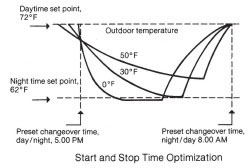
Optimized morning start. This feature adjusts the switch over from night to day schedule depending on the outdoor temperature.
Outdoor cut-off. This feature stops the heat output and pumps above a selected outdoor temperature.
Exercise of valve and/or pump once every 24 hours to prevent sticking.
How much can we save? Most of the savings from an outdoor reset controller come on mild to moderately cold days which mostly happen in the fall and in the spring. This is logical as a heating system is designed to heat the structure on the coldest day and is therefore oversized for mild days. That’s when the outdoor reset controller will throttle back on the heat and save energy.
Sometimes, there are exaggerated claims regarding savings, but the following are some conservative guidelines:
Lowering the average indoor temperature by 1 degree: 2.5% Installing a reset controller without night setback: 5-7 %. Night setback: 5-8 % Automatic curve adjustment: 3-5% Optimized morning start: 5% Outdoor cut-off: 3-5%
The above percentages should be multiplied, not added. Using all the above features should save about 18 %.
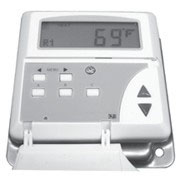
TC204 Outdoor Reset Control from Paxton Corp.