

Drill bits are indispensable tools for the professional contractor as well as the DIY homeowner, and new technologies are giving these toolbox staples more cutting power than ever before. In this article EHT explores a wide range of bit types, their various applications, and the latest technology to increase cutting efficiency.
Twist Bits and Common Materials
The standard twist-type drill bit is the most mass-produced drill bit on the market. The geometry and sharpness of the cutting edges determine the performance of the bit. The most common twist bit has a point angle of 118 degrees, which is suited for all sorts of general purpose tasks. Sharper points, such as a 90-degree angle, provide more aggressive cutting power for materials such as soft plastics. A shallower tip angle, such as 150 degrees, is designed for applications such as drilling steel (but requires a starter hole). The general rule is that harder materials require a large point angle, and softer materials require a sharper angle.
Today’s twist bits are available in several material types. Soft, low-carbon steel bits are inexpensive, but are only used in wood and require frequent sharpening or replacement. High-carbon steel bits are somewhat more durable and can be used in metal or wood, but excessive heat can damage the cutting edge. For better quality and a step up in hardness, high-speed steel bits (HSS) are more tolerant of heat and can drill through softwoods, hardwoods and metal.
Exotic materials are now being used to ramp up the performance of today’s bits. For example, the Cobalt bits from Bosch are designed for drilling the toughest materials, like hardened stainless steel, cast iron and titanium. These bits combine HSS with 6-percent cobalt, which results in a bit that resists up to 1,100 degrees Fahrenheit to drill extremely abrasive materials that would normally destroy other bits.
Tungsten Carbide is an extremely hard material that will stay sharp longer than other bits. However, because the material is so brittle, these bits are typically made of HSS and “tipped” with tungsten carbide, so the bits maintain strength and cut down on cost.
Coatings are another hot trend in drill bits. Heat is the single largest hindrance in the life of the bit, and high-tech coatings help resist heat. A Black Oxide coating can double the life of standard HSS bits for all-purpose drilling in wood, plastic, carbon and alloy steels, aluminum and soft cast iron. Titanium Nitride coating is a very hard ceramic material, and can dramatically extend the life of the cutting edge when used to coat HSS bits. Titanium-coated bits will last up to six times longer than standard Black Oxide bits and cut through more materials.
Diamond powder is another coating used as an abrasive for cutting ceramic, stone and even glass. Diamond bits generate a lot of heat, though, and should be used with water to cool down the cutting process.
Brad-point Bits
Standard twist bits can wander or skate across the work surface, especially if the bit in question has a wide point angle. In metalwork, drilling a pilot hole can compensate for this, but when drilling in wood, it saves time to use only one bit like a brad-point. Similar to a twist bit, a brad-point bit incorporates a spur with a sharp point into the tip of the bit. The sharp point penetrates the work surface to hold the bit in position while the sharp corners surrounding the spur cut the wood. Additionally, with the outside corners of the brad-point bit leading the cutting action, the wood fibers at the edge of the bore are cut for a cleaner hole. Brad-point bits are also effective in soft plastic, but are not generally used for metal because of their tendency to bind.
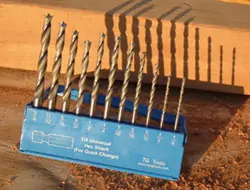
A new concept in brad-point design comes from TG Tools. The Kik brad-point bits from TG Tools are tipped with six cutting edges to provide 20-percent more cutting surface when compared to standard brad-points. This means the Kik bits bore faster, cleaner and last longer due to decreased wear. In fact, the tip cuts so aggressively that it necessitated an extraction ridge inside the flutes to remove material quickly and prevent heat buildup.
Spade Bits
For quick drilling of large holes, spade bits offer plenty of productivity with their paddle-like shape. A typical spade bit is flat with two cutting edges flanking a spur, which guides the trajectory of the drilling. It should be noted that spade bits are intended for rough-in work such as framing, plumbing and electrical work, because their aggressive cutting and high-speed action can leave a splintery hole.
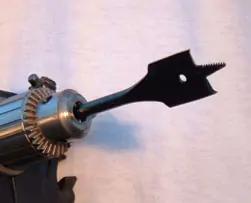
One modern advance in spade-bit design is the inclusion of a threaded spur. For example, the latest spades from Vermont American feature an aggressive spur angle with a threaded tip which works like a screw and literally pulls the bit through the wood for fast cutting action. The self-feeding spades are also available in short “Stubby” lengths.
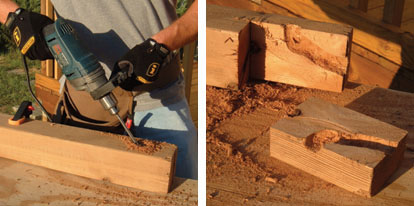
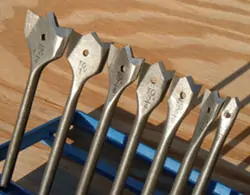
The spade bits from TG Tools employ the same concept as the company’s brad-point line: more cutting edges. Engineered with 30 percent more cutting surface, the Kik spade bits result in faster boring and longer life. Plus, the Kik bits eliminate the spur commonly found on similar bits, which allows these spade bits to drill a curved hole. Great for plumbing and electrical installations, simply start the drilling as usual and you can angle a hand drill as you bore, altering the trajectory of the hole.
Hole Saws
They’re called hole saws, but they fit on a drill—these cup-shaped bits cut out large circles or cores of wood for everything from plumbing to doorknob installation. The M.K. Morse bi-metal hole-saw set sold at Lee Valley Hardware features high-speed steel cutting edges bonded to a steel cup with the added advantage of variable pitch teeth. The repeating pattern of teeth and variable pattern gives smoother cutting in a variety of materials, when compared to the standard wavy pattern of teeth.
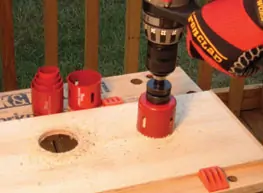
Bosch also has a new line of hole-saw bits that includes quick-change adapter nuts and mandrels that work with almost any manufacturer’s hole-saw cups. (Mandrels are the centering bit and support piece that hold the hole-saw cups.) The quick-change system makes it easy to change cups in seconds and move effortlessly between applications, sizes and materials. Users simply attach the adapters to their cups, drill a hole, and pull back on the mandrel to change cup sizes in seconds. The quick-change system also eliminates the time-consuming task of digging the plug out from the middle of the cup.
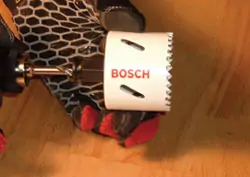
Most hole saws are bi-metal with HSS tips, which are ideal for wood-boring applications. However, Bosch has recently introduced some “specialty” hole saws. Bosch’s sheet-metal hole saw is equipped with a spring for automatic material ejection, variable tooth pitch optimized for fast, precise cutting and a lipped-edge that acts as a safety stopper. This lipped edge prevents breakthrough and leaves the work surface intact.
When working with especially dense materials, Bosch’s new carbide hole saw has diamond-ground carbide teeth that are extremely powerful and durable with drop-shaped chip-clearance slots. The carbide hole saw cuts through wood, ceramic tile, brick and cinder block, cement board, fiber–cement board and plastic.
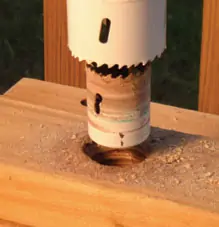
A new accessory for hole saws is a hole-enlarger kit to remedy holes that were originally cut too small. Simply attach the desired hole-saw size to the mandrel, and then use a special threaded center bit to attach the cup that drilled the original hole size. The first cup acts as a pilot guide so the second cup can accurately cut the correct hole size. Hole-enlarging kits are available from Century Drill and Tool as well as Vermont American.
Self-Feeding Wood Bits
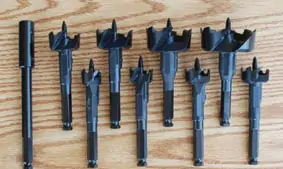
Self-feeding wood bits are used for large hole drilling, similar to hole saws. However, these bits don’t cut cores of wood, they bore through it using a removable, replaceable feed screw that draws the bit into the wood, combined with a cutting plane that shaves the hole radius for clean, smooth holes without pressure. Self-feeding bits are available from M.K. Morse Company and Milwaukee Electric, and the cutting edges can be re-sharpened.
Countersink Pilot Bits
Countersink bits allow you to simultaneously pre-drill screw holes in wood and countersink the holes for recessed screw heads. These bits belong in every toolbox, but are often unduly overlooked by DIY’ers—and the result is split wood when driving the screws. Countersink bits are available in several sizes to match standard screw sizes. Some versions have an adjustable twist bit fitted into the countersink body. To match the bit length to the screw length, just loosen the hex nut on the countersink collar, slide the bit in or out, and then retighten.
Forstner Bits
Named after their inventor, Benjamin Forstner, Forstner bits are the best choice for drilling precise, flat-bottomed holes in wood. Forstner bits have a center spur as a guide and radial cutting edges that shear wood fibers at the edge and bottom of the hole, creating a smooth bore with an exact diameter. They can cut on the edge of a block of wood to create channels, and can also be used to create overlapping holes. Forstner bits require a lot of force to drive them into the wood, so they’re typically used in a drill press. These bits also have no method of clearing wood chips, so they should be retracted periodically to clear the hole.
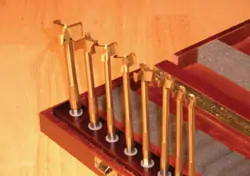
Forstner bits vary in design; some bits have two radial cutting edges, other bits have more. The Forstner bits from TG Tools actually have nine cutting edges, which permit cutting curved paths, channels, routing and milling in wood and plastics. The TG Tools Forstner bit set also come in a nice, dovetailed wooden box.
Step Bits
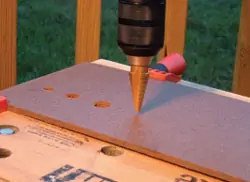
Cone-shaped with a “staircase” profile, step bits can drill a wide range of hole sizes with a single drill bit. The new titanium step bit from Vermont American bores nine different hole sizes, from 1/4 through 3/4 inch in 1/16-inch increments. This single bit bores metal, wood, plastic and PVC. Plus, it automatically deburs the holes as it drills—a nice feature because burring can sometimes be a problem with standard step bits.
Auger Bits
Auger bits are great for boring deep holes to install plumbing or electrical lines. Because they’re intended for deep drilling, they feature a long, deep spiral flute to effectively remove chips. A common 7-inch auger bit can drill through three 2-by-4’s, although some versions, called ship augers, range in size up to 18 inches.
Glass and Tile Bits
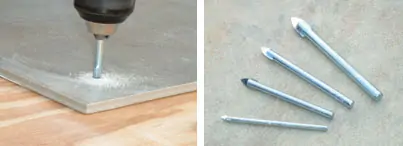
Two types of bits are available for glass and tile drilling. The latest glass-and-tile bits from Vermont American have a spear-pointed carbide tip to reduce breakout. Available in 1/8, 3/16, 1/4, 5/16-inch sizes, these spear bits provide smooth, accurate drilling in ceramic tile, marble, china, mirrors and glass. The bits are ideal for drilling fastener holes in bathroom tile or wall mirrors.
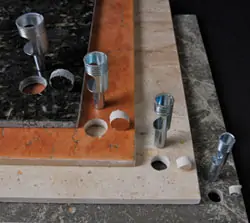
A second concept for glass and tile, Hitachi offers a line of diamond-grit drill bits ranging in size from 3/16 to 1 inch. Utilizing a circular cutting edge, the new Hitachi bits are designed to power through class 5 tile, marble, porcelain, granite, slate and glass quickly and cost effectively.
To use freehand, position the bit at an angle to pilot the hole. Slowly begin the edge of the hole and gradually center the bit directly above, drilling down eliminating the risk of drill bit wander. Use water spray to cool the cutting. As the bit drills down through material, the hollow barrel of the bit creates a core that helps guide the drill and eliminates skating.
Masonry Bits
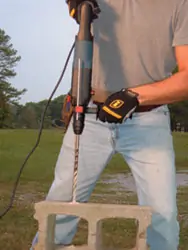
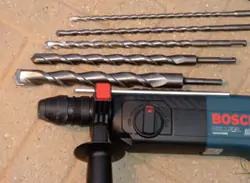
Masonry bits are a variation of the twist-bit-design and are typically used with a hammer drill for its high-impact action. They feature a chisel-like tungsten carbide tip to break up stone, brick or concrete, while the flutes pull back the chipped material. Because these bits occasionally get jammed with crushed masonry, it’s best to operate the hammer drill with a pumping action. Masonry bits are excellent for installing wiring and plumbing in existing structures.
Shop Smart
Obviously, there are tons of drill bits purpose-built for a multitude of different jobs, so avoid the one-type-fits-all mentality. Also consider the construction of the bits—aspects such as a hex shank can offer better grip in the chuck. And, don’t overlook the accessories. While many bits are sold as stand-alone items, many bit sets are sold in carrying cases that vary greatly in quality. You’ll appreciate a well-constructed case and curse a lousy one, when you’re constantly collecting your spilt bits.
Tech Tip: Drill Perfect Holes in Wood with No Tear-Out
For drilling holes in wood with no tearout, there are two possible methods: For fine woodworking applications, use a backer board clamped to the workpiece. Select a good-quality bit with a starting point and side cutters, such as a Forstner or brad-point. The bit treats the two clamped pieces of wood as a single piece; as the drill bit passes through the workpiece and into the backer board, you won’t get tearout on the workpiece. For applications where a precise hole is not required, use a spade bit to drill the hole. When you’ve just about pierced the backside, stop and flip the workpiece over. Use the hole pierced through the backside of the workpiece as a centering guide, and finish the hole from the backside.
—courtesy Vermont American, www.vermontamerican.com
Tech Tip: Drill on a Curved Surface
Here’s a suggestion for drilling a hole on a curved surface, such as moulding. First, use an awl to start the hole in the exact location you want it on the workpiece. This minimizes the possibility of the bit “walking” or “skating” across the workpiece surface when you start to drill the hole. Next, using a twist drill bit, hold the bit perpendicular to that part of the curved surface of your workpiece, and begin drilling to a very shallow depth, no more than 1/8 inch. Once you get the hole started, sweep the bit into position so that it is parallel to the hole you are drilling. Then continue drilling to the desired depth. When finished, the hole will not be completely round, so you might want to use wood putty to plug the uneven hole.
—courtesy Vermont American, www.vermontamerican.com
Tech-Tip: Remove Pitch Buildup from Wood-Boring Bits
After extended use in gummy or sticky wood, a wood-boring bit can become coated with wood pitch. Pitch buildup causes the bit to drag, which can burn some hard woods. Any number of commercial products are sold that can clean and help prevent pitch buildup on bits and blades. Spray-on oven cleaners can do the job. As an alternative method, you can fill an empty coffee can with just enough paint thinner or de-natured alcohol to cover the bit. You must place a cover on the container, as solvents are flammable. Soak the bit overnight. Use a soft brush, such as a toothbrush, to get rid of any remaining residue, then wipe clean with a rag.
—courtesy Vermont American, www.vermontamerican.com
Tech Tip: Enlarge or “Move” a Pre-existing Hole in Fine Woodworking
For enlarging or “moving” pre-existing holes up to 1 inch in diameter, one option is to plug the existing hole with a dowel and then re-drill it. Dowels are available in 1/8-inch increments. Select a dowel that fits snugly in the hole; you should find it necessary to tap it in using a plastic or rawhide mallet. If the hole does not fit one of the dowel’s dimensional sizes, use a larger dowel and taper it to fit the hole using sandpaper. Next, select a good-quality bit with a starting point and side cutters, such as a Forstner or brad point bit, which drill more precise holes than standard twist drill bits. Use a drill press and make sure the workpiece is clamped down to prevent wobble and inaccurate drilling. Drill the hole to your desired depth.
—courtesy Vermont American, www.vermontamerican.com
Sources:
Bosch Power Tools
www.boschtools.com
Century Drill & Tool
www.centurydrill.com
Festool
www.festoolusa.com
Hitachi Power Tools
www.hitachipowertools.com
Metabo Power Tools
www.metabo.us
Milwaukee Electric Tool
www.milwaukeetool.com
M.K. Morse Company
www.mkmorse.com
Vermont American
www.vermontamerican.com