
Visit Extreme How-to for thousands more articles.
  Link to http://www.extremehowto.com
Google


For
related articles

click here
Click here for a printer-friendly
version of this article!

Click here to email
this article to a friend!

Deck Building Basics
Monte Burch


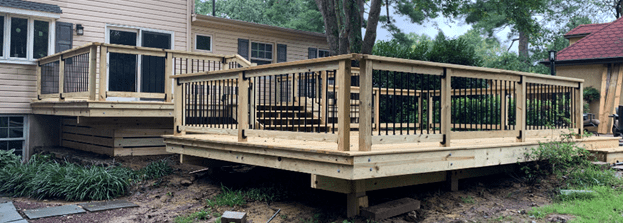
Decks are some of the most popular homeowner projects. They can be a small extension off a family room, bedroom or dining area; or they can be a spacious outdoor room large enough for a party. Decks can be single level or multi-level; they can be some of the simplest first projects for a beginner, or elaborate examples of sophisticated craftsmanship.


Decks are quite often the first project many beginning do-it-yourselfers tackle, but it's important to understand the basics of deck construction. Decks are built in specific steps. By taking those steps one-at-a-time, building a deck can be fun and easy.


<


Planning

The first step is to design and plan your deck. Location is important. Determine its primary use, such as a place for large parties, family relaxing, outdoor cooking or private sunbathing areas. Do you desire sunlight or shade? Do you want privacy? Is there a view you wish to enjoy? How would the deck fit with your general landscaping? How would the deck fit with your existing structures? Consider the safety factors. Will the deck be used by children or older persons? Remember that decks are basically support bases for people to walk on, as well as to support items like flower planters and furniture. They must be constructed strong enough for this support.


Measure the area of the proposed deck and temporarily stake it out with small stakes. Make sure there are no utility or drainage lines running beneath the deck. Contact the local building authorities for any permits, and any code rules or limitations. Some cities, municipalities, communities or subdivisions may restrict the size and height of the deck, as well as the materials. Determine the basic design of the deck, such as posts, beams and other spacing, and prepare a materials list. With this information you can apply for any permits needed.


Materials

Decks must be constructed of long-lasting, moisture-, rot-, decay- and insect-resistant materials. Three basic types of materials can be used.


First, there are naturally insect- and moisture-resistant woods such as redwood or Western Red Cedar. For example, Western Red Cedar fibers contain natural compounds called thujaplicins that act as preservatives. As a result the wood will have a long life without the need for chemical treatments. Plus, the even, consistent grain and low density make cedar less likely to swell, warp, cup and twist than other soft and hard woods. As a result, it lies flat and straight. Cedar is also free of the pitch and resin found in other softwoods a quality that makes it ideal for a wide range of finishes, whether you choose a lightly tinted semi-transparent stain or a two-coat solid color finish. For more information, visit www.wrcla.org.


Second, pressure-treated woods with chemical preservatives, such as Wolmanized Natural Select, are readily available, inexpensive and easy to work with, making them the most widely used material for outdoor structures. For more information, visit www.wolmanized.com.


There's also the option of composite decking materials, which are made from a combination of plastic and wood fibers to provide a low-maintenance alternative to real wood.


Availability, cost, the final design of the deck, as well as personal preferences will determine the materials to be used. Check with your local building supply dealers as to the materials available in your area.


Design

Regardless of how low or high it is built, a deck consists of several basic parts: the footings; posts or vertical support members; the beams or horizontal supports; the joists; the decking and finishing details such as railings and steps. The size and spacing of the different members depends on the design of the deck and the woods being used. The charts at the bottom of this article show the spacing for Wolmanized Natural Select Pressure Treated lumber and for non-stress-graded redwood (Construction Heart) lumber.


Click below to use the Western Red Cedar Lumber Association's online deck design tool!


Laying Out the Deck

It is important the deck be laid out square, and also square with any building it is to be attached to. Even if some of the deck is free-form or rounded, the basic support structure must be squared.


First step is to determine the height of the deck. If the deck is to be attached to a house or building, measure the height of the house floor above your grade line, or at the doorway. Allow a 2- to 4-inch step down from the house floor to the deck level so water won't be allowed to enter the building. Then measure one side to the length needed and drive a stake. Fasten a string to the house at the height determined. Using a string level to create a level line, fasten the string to the stake. Measure for the second corner stake, making sure the measurements are the same. Then measure the distance between the two lines attached to the house and adjust the outrigger stakes so they are the same distance apart. This provides the basic shape. Drive stakes and construct batter boards about 2-feet on either side of the outer stakes. Before fastening the batter boards in place to the stakes, extend string lines across to the batter board tops and, using a string level, make sure the tops of the batter boards are level with the string positions on the house and level with each other.
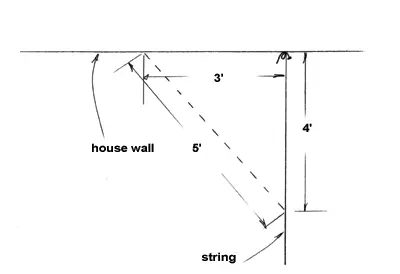
Above: Use the triangle method and string lines with batter boards for laying out the deck., locating the support posts and ensuring the deck support structure is square.


One method of ensuring square is to create a right angle with the string lines. Measure 3 feet from the building along the string and mark this distance with a felt tip pen. Measure 4 feet along the building wall and mark that measurement as well. Measure diagonally between the two marks. The measurement must be 5 feet to create a square corner. Move the string line in or out to achieve the correct measurement. Then fasten the string in the correct location to the batter board. This creates a square corner at the building. Repeat for the opposite edge or side of the deck, from the building out to the second outer stake batter board.


Repeat to locate the outer deck edge. Measure 4 feet from where the string lines cross over the tops of the outside corner stakes along one of the string lines. Mark this location with a felt-tip marker. Measure 3 feet from where the string lines cross on the opposite line and mark this location as well. Measure the distance diagonally between the two marks. It must be 5 feet. Move the strings in or out until you achieve this measurement. This ensures a square, 90-degree corner at this corner. Repeat for the opposite and last corner. Remove the stakes and relocate them directly underneath where each string crosses. This establishes the outside corners. To check for squareness, measure diagonally between each corner stake and the deck corner at the house. These measurements should be equal.


To prevent weeds from growing up through the deck, you may wish to cover the area below the deck with black polyethylene film, and then add gravel, pebbles or bark mulch over the polyethylene.


Deck Construction

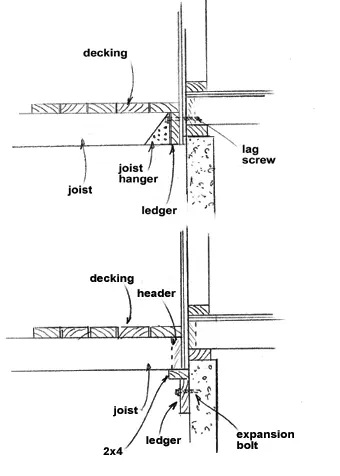
The first construction step is installing a ledger board to support the deck as it is fastened to the building. Position the ledger board in place against the house, making sure it is set low enough for the top decking boards to come to the final deck height. Brace the ledger board in place, make sure it is level, and then nail it in place at both ends, again making sure it is still level. Anchor the ledger firmly to the house using washers and 3⁄8-inch lag bolts that are 2 inches longer than the thickness of the ledger. For masonry walls, use the appropriate masonry anchors.


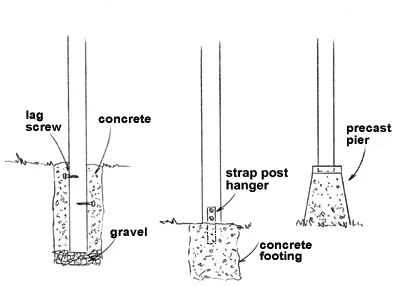
Footings are required to support the posts. These may be concrete blocks, pre-cast pier blocks or poured concrete supports. Footings are usually constructed twice the size of the post they support. Building codes usually dictate the types and sizes of footings allowed. As a general rule, the footings must extend below the frost line. In most soils and locations this will be 2 feet deep. The tops of the footings should be above the ground to keep water away from the posts. In the case of using pressure-treated wood posts, the posts can be set down in the holes, on a layer of concrete, then a layer of gravel. Quikrete suggests pouring dry concrete mix into the hole and around the post until it is approximately 3 to 4 inches from the top. Two 50-pound bags of Quikrete Fast-Setting Concrete Mix will set a 4-by-4 (or 4-inch diameter) post in a 10-inch diameter hole that's 2 feet deep.


Pour water into the dry mix and allow it to soak in. Use at least one gallon of water per each 50-pound bag of concrete. Fill the remainder of the hole with soil dug from the hole. The concrete sets up in about 20 to 40 minutes. Wait four hours before placing heavy objects on the post or moving the posts in any way.


Purchased pier footings are the easiest, but pouring your own concrete footings for posts to rest on is also fairly easy. These can be poured in the dug holes, or cardboard tube forms may be used. Use pre-mixed concrete, such as Quikrete, mixing it in a wheelbarrow and shoveling it into the hole or tube form. If the posts do not sit down in the holes, but are resting on the above-ground footing tops, then the posts must be anchored to the footing. Metal base anchors, such as those from Simpson Strong-Tie Connectors, can be set in the concrete before it sets up. The posts are then fastened to the anchors. Regardless of whether the posts are setting in the holes or on the footings, it's extremely important to make sure the posts are correctly located, and the squareness of the structure is maintained. Make sure the posts are set plumb in both directions. Use 2-by-4 braces temporarily tacked to the posts to keep them plumb until you can install the beams or girders.


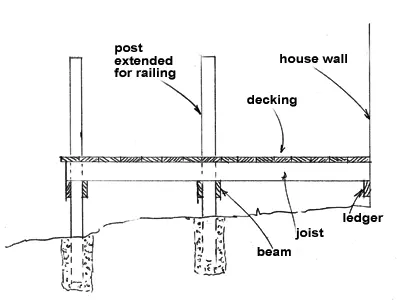
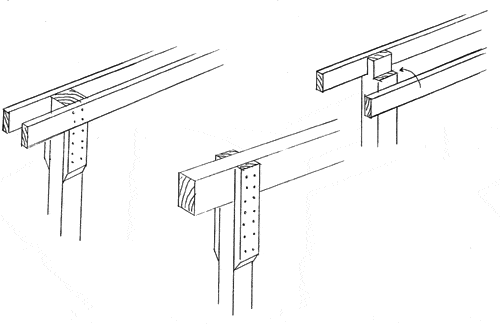
To locate the beams, run a string line, with a string level, from the top of the house ledger plate to the posts. Make sure the line is level. Three methods can be used to fasten the beams in place. If there won't be a railing, cut off the posts to attach the beams, cutting off to match one of the three methods chosen. If a railing is involved, leave the posts full height as railing supports.


Fasten the joists to the beams. One of two methods can be used to anchor the joists in place. Using metal joist hangers is the simplest, cutting the joists to fit between the beams. You can also sit the joists down on top of the ledger plate and outer beam, but this requires more joists and is not quite as neat in appearance. You will also have to have a fascia board to cover the outer ends of the exposed joists. The joists must be spaced according to the deck covering and according to building codes, and this will run from 16 to 24 inches. If the posts are to act as railing supports, add spacer railing-posts, bolting them to the outside beam or girder.  


           Beam fastening options:


Installing the Decking

Decking can be 2-by-4, 2-by-6, or 5/4 decking boards. The decking boards are the most visible aspect of your deck. Install them with care. Begin with the deck board perpendicular to the house. This board will serve as the guide board for all the other deck boards. Install the boards bark-side up to reduce cupping of the board edges. The decking can be installed with galvanized nails, screws or Strong-Tie Deck Board Ties. The latter provides a fastener-free deck surface. Nails, although the most economical fastener option, will eventually pop up, causing problems unless they are designed for deck installation. Nails and/or screws should also be predrilled on some woods to prevent splitting out the ends.


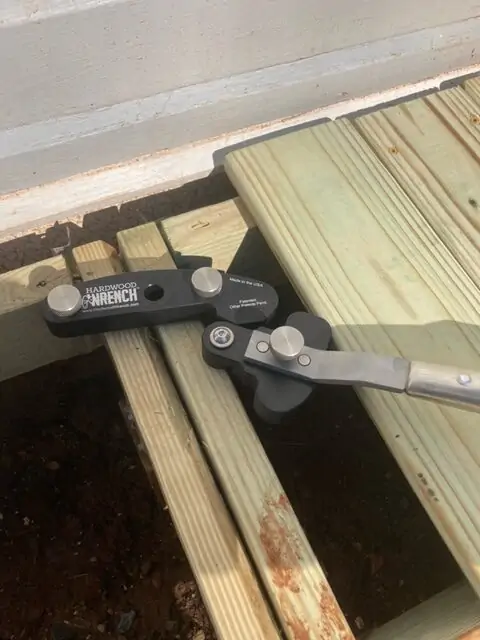
Deck boards can be installed straight, diagonal, herringbone or parquet style for more variety. Regardless, the deck boards should be staggered to allow for any slight movement during the natural seasoning process. Once installed, snap a chalk line on the sides or ends where the boards protrude outside the deck, and then use a circular saw to cut all the boards off evenly. Decking boards will have to be notched to fit around any posts that protrude through the deck. Incidentally, the Vaughan Bowjak makes it easy to straighten and hold warped or crooked deck boards until they can be securely fastened in place.


Deck Finishing Details

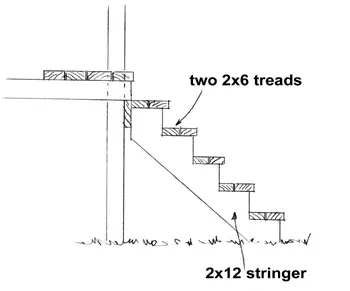
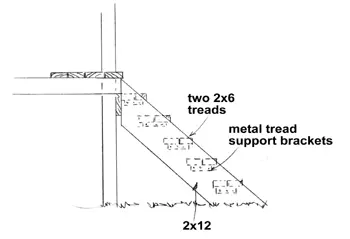
Steps are often needed from the deck to ground level or from one deck level to the next. Steps can be created using a traditional notched stringer system, or you can use Strong-Tie Connector Stair Case Angles. These make it extremely easy to adjust the angle of the stringers to span the distance from the deck to the ground. Measure the rise (vertical height) from grade top to the top of the deck. Divide the rise by 7 inches or whatever stair rise you prefer. This indicates how many stair risers are required. To determine the total run of the stairs, multiply the number of steps required by 11 1⁄4 inches. Cut the 2-by-10 stair stringers and fasten to the deck framing with a Strong-Tie Framing Anchor. Mark the staircase angle support position on both stringers. Install the Staircase Angles with 1⁄4-by-1 1⁄2 inch lag screws and then fasten the stair treads in place. If more than three steps are involved, a hand railing should be added to each side.
 

Railings not only provide safety to higher decks, but also add to the dcor. Most building codes call for a railing if the deck is more than 24-inches off the ground. In the past, railings tended to be straight wood pieces. These days, any number of railing designs is available, including turned spindles and supports.


Composite Decking

Composite deck materials, including deck flooring, rails and balusters do require somewhat different steps in installation. The different products, from the many different manufacturers do require specific installation and construction steps. Most posts and rails come as a system. Make sure you carefully follow manufacturer's instructions with the products purchased. This includes design, such as spacing of the railings and so forth.


Composite materials are not designed for load support. Regardless of the composite decking and railing system chosen, it must first be supported on a wooden framework, in the same construction manner as for a full-wood deck. As an example, the following are a few tips on installation of the ChoiceDek system from Weyerhaeuser.


First step is to assemble the post bracket and fasten to the rim joists. Insert posts into the brackets and connect with the appropriate fasteners. Then install the decking materials, cutting to fit around the posts and leaving a 1/8-inch gap. For a more decorative look, add a post collar over the post. Then attach edge trim to the ends of the decking boards.


Measure and cut the universal support rails and the decorative handrail. Attach with the brackets supplied. Support blocks to match the balusters are suggested for extra strength. Insert the end balusters/spindles tight against the posts, then insert the balusters and fillets to space them properly. Fasten in place with stainless steel fasteners. Fillet spacer blocks may also be glued in place. Install the decorative handrail. Then cut the post tops to the correct size if you haven't already done so. Install the post caps.


Stair railings are installed in the same manner, except with one difference, it's on an angle. Installation requires additional care in measuring, cutting and fitting. The posts are first anchored to the stair stringers. Then the decking material for the steps installed. Again, the universal stair rails are then installed, followed by the balusters, fillets, decorative handrail and post tops.    


Don't be limited in the design of the deck to a floor only. Planter boxes, built-in bench seating, privacy screens, deck covers, even pool and spa surrounds can all add to the beauty, usefulness and enjoyment of a deck for your backyard.


Spec Your Deck

Determining Joist Size

(Based on 12 joist spacing)


 Max. Joist Span:        Max. Joist Span:    

  Southern Pine                 Red Pine              Joist Size:

     Hem-Fir                  Ponderosa Pine     


          9'                        7'6"                                  2 x 6

         12'                      10'                                    2 x 8

         15'                      13'                                    2 x 10


(Based on 16" joist spacing)


 Max. Joist Span:         Max. Joist Span:   

  Southern Pine                 Red Pine               Joist Size:

     Hem-Fir                  Ponderosa Pine


           8'                       6'6"                                   2 x 6

        10'6"                    9'                                       2 x 8

         13'                      11'6"                                  2 x 10


(Based on 24" joist spacing)


 Max. Joist Span:         Max. Joist Span:   

  Southern Pine                 Red Pine               Joist Size:

     Hem-Fir                  Ponderosa Pine


          6'6"                      NA                                   2 x 6

          8'6"                      7'                                     2 x 8

          11'                        9'                                    2 x 10


Determining Beam Size/Post Spacing

(Species: Southern Pine and Hem-Fir)<, /FONT>

<, SPAN style="FONT-FAMILY: , Helvetica"> 

  If joist size is     Use beam size      Max. post spacing


         2 x 6                   (2) 2 x 6                        6'

                                    (2) 2 x 8                        8'


         2 x 8                   (2) 2 x 8                        6'

               , ;                     (2) 2 x 10                      8'


        2 x 10                  (2) 2 x 10                      6'

                                    (2) 2 x 12                      8'


(Species: Red Pine and Ponderosa Pine)


  If joist size is       Use beam size    Max. post spacing


         2 x 6                    (2) 2 x 6                       5'

                                     (2) 2 x 8                       7'


         2 x 8                    (2) 2 x 8                       5'

                                     (2) 2 x 10                     7'


        2 x 10                  (2) 2 x 10                      5'

                                    (2) 2 x 12                      7'


Determining Post Size

(Species: Southern Pine and Hem-Fir)


   Post                Load Area sq. ft.

 Height           

                          48        72        96      120    144


Up to 6'           4 x4     4 x 4    4 x 4    4 x 4    4 x 4

Up to 6'           4 x4     4 x 4    4 x 4    4 x 4    4 x 4


(Species: Red Pine and Ponderosa Pine)


   Post                Load Area sq. ft.

 Height           

                         48        72        96      120    144


Up to 6'           4 x4     4 x 4    4 x 4    4 x 4    4 x 4

Up to 6'           4 x4     4 x 4    4 x 4    4 x 4    4 x 4


Knee bracing should be used for heights over six feet. For heights over eight feet consult a professional engineer.


Suggested Joist Spans

For non stress-graded redwood lumber (Construction Heart), with a live load of 40 lbs. per sq. ft.


Joist    Joist                        Joist

Size    Spacing                  Span


2x6      16 on center         7'3

            24 on center         6'0


2x8      16 on center        10'9

            24 on center         8'9


2x8      16 on center         13'6

            24 on center         11'0


Deflection limited to L/240.


Suggested Beam Spans

For non stress-graded redwood lumber (Construction Heart), with a live load of 40 lbs. per sq. ft. and dead load of 10 lbs. per sq. ft.


Beam                     Beam

Spacing                 Sizes


                       4x6      4x8      4x10


                      Span   Span   Span

6 feet              4'0     5'0     7'3

8 feet              3'3     4'3     6'3

10 feet            3'0     3'9     5'6

12 feet            2'9     3'6     5'0


Beam span is the distance a beam extends from one post to the next. Beam spacing is the distance between beams. Deflection limited to L/240.


SIDE NOTE:

Tips for Installing Pier Footings

Rigid plastic footing forms are new alternatives to conventional forming methods for concrete pier footings. These types of piers are quicker and less expensive to install. The installation for the rigid plastic footing forms is similar to that for conventionally wooden formed footings, but with fewer steps and without the labor and resources necessary to construct wooden form. Typically, modifications to the form itself are made first, such as adjusting the top opening size to match the diameter of the construction tube for the connected pier and then attaching the construction tube to the footing form with screws.

Excavation to below the frost line and preparation of the area for the footing which must be placed on level, undisturbed soil or on 4" to 6" of compacted crushed stone or gravel which is then followed by placement and leveling of the footing form in the excavation. The usual procedure to backfill (without mechanical compaction / tamping) is completed before the concrete is poured. Another plastic footing form when inverted can function as a funnel for the pour. Once the pour is complete and the funnel is removed, all potential unfinished settling and air pockets are removed with tamping or vibration and additional concrete, as necessary. Place three to four #4 or #5 rebar in the construction tube extending approximately 6 in. below the bottom ring of the footing form. The top surface may be trowel finished. If an anchor bolt is required, it is inserted at this last stage of installation. Ridge forms used below grade stay in place. For more information, visit www.bigfootsystems.com.


Other Related Articles


Prevent Home Electrical Fires
Everything Auto: DIY Wheel Alignment
Install a Rock Floor Inside Your Home
Prevent Home Electrical Fires
A Guide to Pressure Washers
A Lesson in Lathes
Fix Common Clog Problems
Remodel Your Attic Space
DIY Closet Shelves
A Radiant Restoration
A Smart Way to Frame a Corner
A Solid Choice: DIY Solid Surface Countertop
A Tunnel for the Sun
Adding Style with Wainscoting
All About Sanders
All Fenced In
All Hands on Deck
Alternative Trim: The Power of Plastics
Everything Auto: Aluminum Wheel Repair
Everything Auto: Alternator Check and Replacement
Everything Auto: Automatic Transmission Service
Backyard Gardening
Backyard Gazebos
Backyard Planters: Big & Small
Backyard Ponds Get A Makeover
Basement Dweller: Remodeling Tips
Up Close with Tankless Water Heaters
Big Storage Below the Deck
Block by Block: Segmental Retaining Walls
Fighting Allergic Asthma in the Home
Brick Picks
Bringing in the Light: Install a Skylight
Build a Garden Tool Shed
Build an Air-Station Assembly Table
Build Your Own Patio
Building a Drive-Thru Backyard Shed
Building a Red Cedar Pergola
Building a Swing Arbor
How to Build Stairs
Building with Glue-Laminated Beams
Cabinet Building Basics for DIY'ers
Everything Auto: Car Care Tips
How to Light Kitchens and Baths
Building a Fireplace Mantel
Chainsaws 101
Chalk it up to Caulk
Choosing a Tiller
Choosing Lumber for Your Deck
Everything Auto: Clutch Play
Common Framing Errors with Engineered Wood
Concrete Creations
Cooling Off with Fresh Air - Whole House Fans
Counter Culture: DIY Plastic Laminate Countertop
Covering Your Ground: Carpet Installation
Creative Concrete Stamping
Crown Molding ABC's
Curb Appeal 101: Cedar Siding Upgrade
Everything Auto: Dash Painting
Deck Helpers: Innovations and Accessories
Design with Flexibility -- Ceramic Tile Installation
Designing a Sprinkler System
Diggin' Peace: Create a Water Garden
Everything Auto: Distributor Cap Replacement
DIY Acoustic Ceiling Tile
DIY Garden Benches
DIY Container Water Garden
DIY Crown Molding & Trim
Do-It-Yourself: Joining Wood Made Simple
Don't Forget the Deck When Winterizing the Yard
Dovetail Joints for Quality Construction
Drills and Drivers Unplugged
Drywall Tips from the Pros
12-Step Toilet Installation
13 Pro Tips for Crown Molding and Trim
A Closer Look at Composite Decking
A Good Look at Greenhouses
How to Use Hand Planes
Inside HOUSE RULES
Everything Auto: Install a Precision Sport Shifter
Install a Whole House Fan
Installing a Floating Subfloor
Installing Doorknobs and Locks
Build a Roll-around Tool Cabinet
Keeping the Water at Bay: Build a Sea Wall
Lawn Aeration
Lawn Care Tips from a Pro
Lawn Edgers Are Put to the Test
Make a Statement with Brick Pavers
Make New Cabinets Old
Matchmaking for Windows
Material Market
Material Market: Counter Culture
Material Market: New Floor Materials
Material Market: Siding Selections
Mortise and Tenon Joints
New Options in Concrete Decor
Build an Office Desk
Open Sesame! Install a Garage Door
Organize This: Build Storage Shelves
Organizing the Home Workshop
Out with Old Grout
Plate Compactor Basics for the DIY'er
Paint it Beautiful
Build a Bar Pass-Through
Everything Auto: Turbocharger Basics
Prep Steps for Outdoor Painting
Everything Auto - Windshield Chip Repair
Everything Auto: Adding Tubular Sidesteps
Everything Auto: CV-Joint Rehab
Everything Auto: Getting Greased
Everything Auto: Replacing Ball Joints
Everything Auto: Replacing Rotors, when your discs have seen better days
Exterior Finishes For Wood
Extreme Woodwork: From Trees to Lumber
Fast and True Deck Framing
Faux-to Finish
Fight Wood Rot
Finishing Moves: Repairing Hardwood Floors
Fire Up the Brick Barbecue
Flooring in a Snap: Installing Laminates
Flushing Upward
From Slicing to Sliding: Adding a Deck Door
From Window to Wall
Getting Jiggy
Everything Auto: Getting Rid of Motor Muck
Getting Wired
Girl Power
Give Wood Furniture a Great Look
Giving Walls a Drywall Update
Goodbye to Water Worries - Install a Shower Pan & Liner
Grasscycling: Waste Not, Want Not
Gutter Repair, Installation and Upgrade
Home Wiring for the Information Age
Professional Tile Layout
Putting Up Knockdown Texture
Recip Saw Roundup
Wood Refinishing 101
Renewing Plaster Walls
Everything Auto: Replacing a Water Pump
Everything Auto: Replacing Brake Shoes
Everything Auto: Replacing Disc Brake Pads
Everything Auto: Replacing Tie-Rod Ends
Everything Auto: Replacing Window Door Glass
Restoring Tile Grout
Righting the Wrongs with IN A FIX
Roof Flashing Done Right
Roof of Steel
Roofing Done the Right Way
Roofing Revisited
Save Money: Rent Lawn and Garden Equipment
Scouting Out Routers
Selecting a Hardwood Entry
Selecting Engineered Wood
Serenity Now! Build a Gazebo
Sinks with Style
Skill Savvy
Soldering Copper Tube
Spring Into Action
Prevent Mold in the Home
Stone Age: Simple Stone Projects
Everything Auto: Build an Auto Storage Box
The Beauty of Bamboo Flooring
Everything Auto: Buying a Diesel
The Bright Outdoors: Landscape Lighting
The Grass is Always Greener
The Ins and Outs of Gutters and Downspouts
Screened Porch
The Latest in Kitchen Cabinets
The Lowdown on Cork Flooring
The New Face of Bamboo
The New Face of Vinyl Siding
Enhance a Room with Skylights
The Wonders of Wood Siding
Tips From a Scroll Saw Pro
To Build a Better Home
Tool School: Circular Saws
Exploring Lithium-Ion Power Tools
Tool School: Choosing Air Compressors and Air Tools
Tool School: Hammer Drills and Masonry Bits
Tool School: Radial Arm Saws
Top Tips for Installing Vinyl Siding
Up Close with Table Saws
Upward Thinking: Overhead Storage Space
Wall Tile Tips from a Pro
Waves of Warmth: Radiant Heat Flooring
Welding 101
Close Look at Drill Bits
Windows of Opportunity: DIY Window Replacement
Winterize Your Home
Working with Concrete
Working with Copper Pipe
Working with Steel Pipe
Working with Wood Filler
Working with Wood Stains: Inside and Out
Everything Auto: Wrangle More Power
Spray-in-Place Concrete Fencing
Trimming Out a Room
Revitalize a Dormant Lawn
Build a Locking Tool Cabinet
Up Close with Circular Saws
Easy Garage Storage
Everything Auto: DIY U-Joint Replacement
Build a Basic Case of Shelves
Installing a PVC Deck Rail
DIY Shop and Garage Heating
Pro Tips For Tongue & Groove Flooring
Build a Playground Slide
Brighten Up with Landscape Lighting
Drywall: Handy Tools, Smart Techniques
Hammers and Nails
DIY Drywall Repair
Sealing and Waterproofing
Cedar Siding Success
Everything Auto: How to Install a Ram-air Hood
A Close Look at Asphalt Roofs
A World of Uses for the RotoZip
Creating Super Wood Joints
All About Band Saws
Hot Alternatives to Home Heating
Patching & Repairing Concrete
Strong, Sturdy Retaining Walls
Guard Your Home from Electrical Fires
Everything Auto: Automotive Radiator Repair
How to Select a Wood-Burning Stove
How to Install Wainscoting
The Low Down on Low Decks
Crown Molding Basics: Tips and Tricks
How to Finish Pine Furniture
Choosing a Metal Roof
Everything Auto: Install a Throttle Body Spacer
Making Magic with Your Router
New Garage Floor Lifts Spirits of Injured Auto Enthusiast
Painting Kitchen Cabinets
EHT's New Digital Magazine
One-Day Garage Makeover
Skil's Octo Sander
Dressing Up Windows and Doors
Simply Radiant
Air Power
Decked Out with Accessories
Deck Makeover
Window Trim Basics
How to Use a Layout Square
Detailing your Deck
11 Keys to Stain Your Deck like a Pro
DIY Deck Remodeling
High-Pressure Cleaning
Build an Attached Carport
Outfitting a Kitchen
How to Sand and Finish Wood Floors
Everything Auto: Install an Alarm
Under Floor Heating
How to Install Skylights
How to Cope Base Molding
Five Garden Projects You Can Build
Deck Basics for DIY'ers
Troubleshooting Toilets
Installing Slate Tile
Build a Butcher Block Countertop
DIY Gluing Tips
Installing Integrated Deck Handrails
Radical Re-deck
DIY Outdoor Lawn Furniture
Install an Ornamental Metal Fence
Soffits Up Close
Build a Deck Sunroof
Build a Home Library
Making Frame and Panel Doors
Pinning Down Nailers and Staplers
Congratulations to EHT's Sweepstakes Winner!
Build a Classic Workbench
Build a Retaining Wall
Re-Laminate Your Countertops
Build a Gun/Trophy Case
The Latest Ladders & Ladder Accessories
Drill Bit Update
Install an Exterior Door
Build a Classic Workbench
Molding Magic
Decking Done Right with David Billings
Everything Auto: Performance Coilover Suspension System
Woodworking Helpers
Install Deck Lighting & Accessories
Install Snap-Together Garage Tile
Everything Auto: Battery Basics
How to Replace a Window
Do-it-Yourself Cedar Siding
New Cordless Drill/Drivers
Make a Mantel Shelf
Everything Auto: Paint the Chassis for Rust Resistance
DIY Laminate Floor Installation
Spray Foam Saves Energy
Warming Up with Radiant Heat
How To Clean Brick Stains
How Long Should Concrete Cure?
Pro Tips on Built-up Crown Molding
Fix a Door Hinge
Grout Stuck in a Tub
Paint Aluminum Siding
Oven Burner: Fix or Replace?
Repair Loose Siding
Repair a Vinyl Floor Seam
Fix a Bouncy Deck
DIY Fountain Kits
Don't Cover Turbine Vents
Easy-to-Build Workbench
Refinishing Hardwood Floors for the DIY'er
Cutting Costs by Building Smart
Fix a Metal Handrail
Repair a Crack in Drywall
Repair a Stone Patio
Drippy Heat Pump
How to Cut Cement Board
Add Eave Vents
DIY Wallpaper tip
Build a Porch Swing
Pro Tips for Paint Brushes and Rollers
Installing a Front-Mount Receiver for a Winch or Trailer Hitch
How to Apply Primer Like a Pro
Remove Paint from Concrete
Can a DIY'er Re-shingle a Roof?
Deodorize your Air Conditioner
Should I Insulate my Crawlspace?
How Do I Prevent Puddling on my Deck?
How to Clean Hardwoods
How Can I Solve a Serious Toilet Clog (Bar of Soap)?
How Do I Install Quarter-Round Trim?
What's the Best Drill Bit for the Job?
How Do I Stop a Chimney Backdraft?
The Grout Gun: Reader Tip for Grout Application
How Do I Hang Drywall?
Should I Use Textured Paint?
How Do I Become a Professional Contractor?
Should I Use PT Lumber for a Shed?
How to Install Roof Sheathing
How to Remove a Stripped Screw
Stucco a Foundation
Should I Tile a Tub?
Installing Crown Molding Solo
Reduce Wood Warping
How to Calculate Concrete Required
Re-Laminate over Existing Laminate Countertops
Paint Vinyl Siding
Taping Inside Corners of Drywall
What's the Difference in Granite Countertops?
Can I Match Roof Shingles?
Stop Pipes from Banging
Installing Base Molding
PVC as a Backsplash?
A Good Start-up Toolbox
Caulk a Tub with the Right Stuff
Five Lathe Projects You Can Build
Building Basic Closet Shelving
Install Column Wraps for a Stylish Front Porch
DIY Thermostat Upgrade
Build a Brick Garden Wall
Outdoor Living Spaces
Security Solution
Repair a Run in Carpet
Clean your Gutters the Easy Way (Reader Tip)
Repair a Shower Head
Upgrade Your Truck's Exhaust System
Clean Oil Stains from the Driveway
Repair Damaged Plaster
DIY Block Windows (Glass vs. Acrylic)
Refinish a Tub
Which Flooring Over Concrete?
Checking Your Tire Pressure is as Easy as Pumping Gas
Video: Deck Recovery
Chainsaw Rx
Next-Gen Decks
Installing a Tile Pattern Laminate Floor
Pour a Concrete Floor
How to Install Vinyl Siding like the Pros
Build a Carpenter's Box
Home Stretch
Congratulations to June's Skil Sweepstakes Winner!
Kit-Built Log Homes
Build a Squeak-Free Floor
Everything Auto: Anti-Sway Bar Install
Installing Granite Countertops
Converting a Closet to Cabinets
Wiring a Garden Shed
Build Your Outdoor Living Room
Understanding House Framing
Replace an Old Deck with Composite Decking
Tighter Miters
Adjustable Pliers & Wrenches
Think Green with Cordless Lawn Tools
Building Shop Shelves
How to Choose Lumber for Outdoor Projects
Demolition Devices
Circular Saw Blades Up Close
Best New Products for Your Deck
Replace an Old Mower Deck
Router Essentials
Fireplace Safety: Avoiding the Dangers of Creosote Buildup
Building a Cooking Table for Your Ceramic Grill
The Kitchen Facelift
Roof Framing 101
Fix a Squeaky Floor from Above
Why Choose a Tankless Water Heater?
Remove Candle Wax from Carpet
Quick Fix for Squeaky Hinge
Pressure Problem with Faucet
Flatten Plywood Subfloor for New Flooring
Prep Floor for Peel & Stick Tile
Replace an Interior Door
The Summer Digital Issue is Now Live!!
Do-it-Yourself Brick Patio & Walk
Crown Molding in Review
Making Outdoor Log Furniture is Quick and Easy
Install a Patio Door
How To Build a Bar Stool
13 Pro Tips for Crown Molding
Bathroom Design Guide, by Sunset Books
Master Suite Masterpiece
Wood Handle Replacement for Striking Tools
Heated Tile in a Snap
Bathroom Redo
Hot Water Options
Christmas Presents You Can Build
Gasket Replacement for Ceramic Grills
Organize Your Kitchen with Rev-a Shelf
Save Energy with Insulated Siding
Working for the Clampdown
How to Remove Wallpaper
Holiday Digital Issue is Now Live
What are Architectural Shingles?
How to Apply Stucco to Concrete Block
Is this Old Paint Oil- or Latex-based?
Is the Plumbing Clog in the Drain or Septic Tank?
Fix a Noisy Ceiling Fan
Adjust an Automatic Garage Door
How to Paint a Steel Door
Can I Install a Toilet where there is No Drain?
How to Shim a Granite Countertop
Use UV light to Clean HVAC System
How Do I Match Old Brick?
Troubleshoot Automatic Garage Door Opener
Prevent Mold on Bathroom Caulk
Keep Mice Away from the House
How to Install Outlet Extensions
Installing a Brick Accent Wall
Down on the Farm, Up Goes a Wall
How to Bend Drywall
Use House Wrap on a Shed
DIY Faux Finish: Stippling
Creating Concrete Sculptures
How to Eliminate Floor Pops
Can New Tile Go Over Old Tile?
Keep Ceiling Joists Level when Installing
Adding a Camo Wrap
Replace an Old Roof With New Shingles
DIY Storage Helpers
Extreme Outdoor Cooking Center
Repair a Kitchen Cabinet
Woodworking Tools 2008
Solving Common Household Drain Problems
Sealing Interior Brick
How to Remove a Popcorn Ceiling
Extra-Mile Hero Contest
Install Mosaic Floor Tile
Stock Parts, Custom Door
Cordless Fastening in Tight Spots
Heating Homes with Hot Water
Just Getting Started
Build a Temporary Closet
Hardwoods in a Heartbeat
Fold Away Hide Away
Installing a Synthetic Railing System
Build a Shadowbox Privacy Fence
Today's Handsaws
How to Make a Knife
The Fun and Fascination of Wallpaper
Do-it-yourself Mirror Frames
Window Re-View
Remodel with Prefinished Stair Treads
Build an Oak and Walnut Nightstand
Five Portable Workstations Reviewed
Tiling Over Concrete
Replace a Ceiling Fixture
Exterior Wood Coatings
How Do I Lay Sod on a Lawn?
Should I Use Faced Insulation?
Deck Demolition Made Easy
Easy Homemade Wood Jigs
Build a Kid's Cubby
Siding Maintenance & Repairs
Choosing a Pool Location
A Home with a Personal Stamp
Adding a PVC Jamb Extension
Bathroom on a Budget
Everything Auto: Upward Thinking with Overhead Consoles
How to Preserve the Look of Copper
How Soon to Paint Concrete?
How to Repair Worn Hardwoods
How Do I Add a Dimmer Switch?
How Do I Connect an Ice Maker Supply Line?
What is an Incinerating Toilet?
How Do I Remove a Mirror from a Wall?
How to Fix a Bi-fold Door that Sticks
How Do I Build a Fence Gate?
How to Remove a Water Stain from Hardwoods
How to Repair a Sagging Floor
Hot Products April 2009
Energy Efficiency in the Home
Expert Advice on Planning a Kitchen
DIY Tile Countertop
Trim Tips for Doors and Windows
Adding a Cased Opening for Windows and Doors
Working with Crown Molding
Base Molding, Learning to Cope
Installing Toilets, the 12 Step Method
How-To Wire Split Receptacles
Install Landscape Lighting
Interior Rock Floor Installation
Refinishing Cabinets to Look Old
Refinishing Kitchen Cabinets for the D-I-Y
Installing Rods and Hardware
Installing Window Treatments
Extreme How-To's Guide to Painting
Bookshelves You Can Build Yourself
Build a Patio or Walkway from Pavers
Build a Patio Using Pavers
Build a Firepit
How to Repair/Replace a faucet
Replacing a Faucet
Build a Stone Firepit
Install Utility Sink
Adding Wire Shelving to Your Closet
Deck Lighting
Installing Laminate Tiles
Countertop Pros and Cons
How to Repair a Cracked Porch
Clipped-Head or Round-Head Nailer?
Invisible Cold Air Return (Reader Tip)
How Do I Build a Header?
Reinventing a 100-Year-Old Bedroom
Surviving Extreme Winds
An Overview of Today's Powered Hand Sanders
Replacing Drawer Slides
Handy Drywall Tools
How to Make Cope Joints in Molding
Paint with Success
How to Build Deck Stairs
Brand New Tune
Tips on Cleaning and Staining Your Deck
Island Workspace for The Kitchen
How to Build a Bar Pass-through
Deck Framing Gone Wild
New Tools for the Green Season
Bright Ideas for Deck Lights
Grid Guidelines for a Great Look
Building a Pergola
Concrete Patio Stamped with Style
Cordless Tool Update
Installing a New Tub or Shower
Test Page for Iframe link
Artificial Stone up Close
Paint a Countertop to Look Like Granite
DIY Countertops with Solid Surface Material
Build a Spiral Staircase
Easy Steps to Replacing a Bay Window
Deck Product Roundup
Waterproofing Basement Walls
Open to Change
All About Insulation
How-To Stain or Paint a Deck
Adding a Kitchen Island
Bathroom Vanity Installation
Level-headed
DIY Shock & Strut Installation
Your House is a System
Coat of Armor for Outdoor Wood
Install Plywood Underlayment for Vinyl Flooring
When to Install New Shingles
Can I Paint Asphalt Roof Shingles?
How to Paint Baseboard Heaters
What is the Best Firewood?
How Does a Heat Pump Work?
How to Refinish a Clawfoot Tub
How to Paint Window Shutters
Installing Wainscoting Adds Style
Installing a Shower Pan Liner
Installing a Laminate Floor
Installing Granite Countertops
Installing a Ceiling Fan
Ceiling Fan Installation
Selecting Energy-Efficient Replacement Windows
Comment construire l'escalier French Version of How To Build Stairs
Extreme How-To leert Trap bouwen "How To Build Stairs, Dutch Version"
ɊK'ig\'z邽߂̎菇ł How To Build Stairs Japanese Version
Happiness is a Warm Shower
Q&A
Tool Transport
How to Stop Water Intrusion on Foundation Block
Repair a Metal Chair
Wallpaper Installation
"Extreme How-To" Uč Jak se stav schody.
Subfloors and Underlayments
The Laminate Flooring Boom
Sidewalk Repair for the Do It Yourselfer
Creating a Workshop
Inexpensive Kitchen Makeover Using Tile as a Countertop Material
Adding a deck canopy/pergola
Tips for Building a Retaining Wall
Adding Lighting to Your House Interior
Fantastic, Fun, Furniture Finishes
Gutters & Downspouts for the DIY'er
Build a Basic Set of Shelves
Replacing Old Aluminum Windows
Build a Deck
Upgrade Your Garage or Workshop
Cmo Construir Escaleras
"Extreme How-To" Wird Erlutert, Wie Treppen Stellen.
" How-To "
Extreme How-To lr ut hur man bygger Trappor. How To Build Stairs
Building Stairs Hindi Version
Building Stairs Chinese 建筑楼梯的说明


CORK FLOORING ARCHIVED ARTICLES VIDEOS PRODUCT/SERVICES DIRECTORY PRODUCT NEWS ABOUT US SUBSCRIPTION SERVICES MEDIA KIT HOW TO FORUM CONTACT US YELLOW PAGES HOME


© Copyright    All Rights Reserved
Privacy  Sitemap  FTC Disclosure